Showing posts with label GMO Crops. Show all posts

Wednesday, February 5, 2014

New Research Fuels Roundup Weedkiller Toxicity Concerns

February 04, 2014
By Dr. Mercola
Source: Mercola.com

 
By Dr. Mercola
Last year, groundbreaking research was published suggesting that glyphosate, the active ingredient in Monsanto's broad-spectrum herbicide Roundup, might be "a crucially important factor in the development of multiple chronic diseases and conditions."

If you missed it, please take the time to listen to Jeff Smith's interview with one of the authors of that research, Dr. Stephanie Seneff, reposted above. The lead author and researcher on this groundbreaking study was Anthony Samsel. 

They spray nearly one BILLION pounds of Roundup  every year for conventional crop production, but genetically engineered (GE) crops see some of the heaviest use, as so-called Roundup Ready crops are designed to withstand otherwise lethal doses of this chemical.
Tests published last year also showed that people in 18 countries across Europe have glyphosate in their bodies,1 while yet a third study revealed the chemical has estrogenic properties and drive breast cancer proliferation in the parts-per-trillion range.2


Now, research published in the International Journal of Toxicology3 in January adds even more fuel to the fire, as it reveals that glyphosate-based formulations like Roundup pose a threat to human health through cytotoxicity and oxidative effects. Such formulations were also found to be lethal to human liver cells.

You may think you are safe if you only eat organic produce but nothing could be further from the truth as most of the glyphosate contaminated crops are fed to animals. This means you also need to get organic meat and eggs. Also, beware you CANNOT wash glyphosate off your produce as it is actively integrated into every cell in the plant and impossible to wash off.

Commercial Formulations of Glyphosate Threaten Human Health

The researchers found that while glyphosate and its amino acid metabolite, aminomethylphosphonic acid (AMPA) in isolation appears to be non-toxic to human cells, toxicity does become a concern when glyphosate is added to other ingredients found in commercial formulations.

It's also well worth noting that the featured study assessed the effects of glyphosate-based formulations on human cells at dilutions that are far below normal agricultural applications. As reported by the featured article by GreenMedInfo.com:4
"The researchers discovered that while glyphosate and its amino acid metabolite, aminomethylphosphonic acid (AMPA), showed little to no observable toxic effects in isolation, a glyphosate-based formulation containing adjuvants produced a variety of adverse effects on cellular oxidative balance, including the following signs of oxidative stress:
  • Increases in reactive oxygen species
  • Increases in nitrotyrosine formation
  • Increases in superoxide dismutase activity
  • Increases in glutathione levels
The glyphosate formulation studied also triggered two 'death proteins' in human cells known as caspase 3/7, inducing pathways that activate programmed cell death (apoptosis), a clear sign of significant toxicity."
According to the authors:
"These results confirm that G [glyphosate] formulations have adjuvants working together with the active ingredient and causing toxic effects that are not seen with acid glyphosate...
Altogether, these results challenge the establishment of guidance values such as the acceptable daily intake of glyphosate, when these are mostly based on a long term in vivo test of glyphosate alone.
Since pesticides are always used with adjuvants that could change their toxicity, the necessity to assess their whole formulations as mixtures becomes obvious. This challenges the concept of active principle of pesticides for non-target species."

Glyphosate in Isolation Preferentially Targets Beneficial Bacteria

Please note that in my earlier interviews with Dr. Don Huber, who is one of the most prominent scientific experts in plant toxicology, he firmly believe glyphosate is FAR more toxic and dangerous than DDT.

Previous research also shows that glyphosate alone wreaks havoc on soil and gut bacteria, so while glyphosate in isolation may not be able to kill your liver cells, it has been shown to wreak havoc on the beneficial bacteria that are absolutely critical to your overall health. Your gut bacteria (opposed to other human cells) are a key component of glyphosate's primary mechanism of harm, as microbes have the same pathway used by glyphosate to kill weeds.
The issue of glyphosate toxicity—whether in isolation or in formulation—implicates genetically engineered foods as being potentially far more hazardous to your health than less contaminated crops, and is indeed a significant reason for opting for organically-grown foods.

Labeling GMOs could help you select products that are less likely to have heavy contamination, although you'd also avoid many other hazardous chemicals used in conventional farming by opting for products labeled 100% organic.

There's also the environmental angle, as glyphosate also effectively kills beneficial soil microbes and damages the fertility of the soil. Glyphosate is in fact patented as an antibiotic, and killing bacteria is the main function of such drugs. It's also a potent chelator, which prevents valuable minerals like iron, calcium, manganese, and zinc from being utilized by the plant.

As previously explained by plant pathologist Dr. Don Huber, genetically engineered (GE) foods, as well as conventional crops that are heavily sprayed with glyphosate, have lower nutrient density than organic foods for this very reason. GE crops also contain high amounts of pesticides with documented harmful health effects, along with novel, highly allergenic, proteins.
Glyphosate's chelating and antibacterial activities also promote soil and plant disease, including but not limited to fungal root disease, highlighted by USDA scientist Robert Kremer in a previous Mother Jones article.5 The chemical's damaging effect on soil has a detrimental effect on yields too, of course, which appears to be part of the explanation for why the chemical technology industry's promises of improving yields have largely fallen flat. The only "yield" that's really gone up is that of glyphosate-resistant superweeds which, as of 2012, affected nearly half (49 percent) of American farmers!6 That was up from a reported 34 percent of farmers in 2011, so clearly, the spread of resistance is swift, and the entire agricultural system is at stake.

Global Land Crisis and the Threat of Worldwide Famine

In related news,7 a recently published paper in the journal Science8 by a Colorado research team found that modern chemical-based agriculture has "drastically altered" the biology of American farmland across the prairies, concluding that: "The soils currently found throughout the region bear little resemblance to their pre-agricultural state."

The paper calls for dramatic and swift changes to our agricultural system, stating that it's the "only viable route to feeding the world and keeping it habitable." A key factor causing the rapid degradation of soil, topsoil erosion, and declining soil fertility, is the adverse effect that agricultural chemicals have on the soil.

Academic analysts from South Africa's Witwatersrand University also weighed in on the issue, warning that unless we change course in how food is grown, we will repeat the same mistakes committed by civilizations in the past, where overexploitation of the land resulted in a vicious circle of famine and social disintegration... To learn more, you can review the PDF booklet, Food Plague Primer: Glyphosate and Genetically Engineered Crops,9 which is a free preview to the book: Food Plague: Could our daily bread be our most deadly exposure,10 written by Arden Andersen PhD, DO, who is both a medical doctor and horticulturist.

Food Industry Pulls Out All the Stops to Prevent GMO Labeling

There's also important news from the GMO labeling front. I recently told you about the Grocery Manufacturers Association of America's (GMA) multi-pronged game plan for preventing US states from implementing any kind of GMO labeling. A major part of the GMA's plan is to prevent states from creating their own labeling laws by pushing for an industry-friendly, voluntary labeling law at the federal level. But that's not all.

A GMA document11 created for use by industry lobbyists also lays out a clear-cut strategy for addressing any state that successfully implements a GMO labeling law, stating that, "The first state to implement a GMO labeling law will be sued on the constitutional grounds seen in IDFA v. Amestoy."Costly litigation is clearly part of the GMA's master plan to protect industry profits in the face of growing consumer awareness about the many problems inherent with potentially toxic, genetically engineered, and grossly adulterated, processed foods.
Maine and Connecticut both passed GMO labeling laws last year, but they contain "trigger" clauses that prevent them from taking effect until or unless at least four neighboring states, with a combined population of at least 20 million inhabitants, pass similar bills.

Vermont also produced a GMO labeling bill in 2012, which was quickly put on ice when Monsanto threatened to sue the state. Still, Vermonters pushed through and, last year, the Vermont House of Representatives passed H.112, which would require GE foods to be labeled as such, and would prohibit GE foods from being labeled "natural." While the bill didn't make it into the Senate before the end of the legislative session in 2013, now that the state legislature has reconvened, the bill has been taken up by the Senate's Agriculture Committee.

The problem Vermont now faces for the second time is the threat of being sued by the industry. The GMA document referred to above falsely insinuates that GMO labeling is in violation of the First Amendment, which protects commercial speech, and therefore unconstitutional.

Breaking News: Highest Rated Law Firm Confirms GMO Labeling IS Constitutional

Alas, one of the highest rated law firms in the US, Emord & Associates, has analyzed the Vermont Genetically Engineered Labeling Bill, H.112, concluding that the bill is, in fact, constitutional.12, 13 Emord & Associates is an AV-rated constitutional and administrative law firm located in Washington, D.C., Clifton, Virginia, and Chandler, Arizona.
An AV rating is the highest rating a law firm can achieve, based on legal ability and ethics, from the Martindale-Hubbell organization. Since 1999, the firm has successfully represented clients in eight First Amendment challenges against the Food and Drug Administration (FDA). The Vermont Law School's Environmental and Natural Resources Law Clinic has also concluded that Vermont's GMO labeling bill would withstand a legal challenge from industry, stating that:14
"We have researched and analyzed challenges that may be made in opposition to such legislation and have concluded that Vermont can pass GE labeling legislation that will meet all constitutional requirements."
That said, the threat of costly legal battles may still have a cooling effect on legislators that would otherwise support GMO labeling, which is surely the GMA's intent. As reported by the Organic Consumers Association:15
"...GMO labeling activists are also concerned that some lawmakers will use the GMA's threats as a convenient excuse to reject the majority opinion of their voters, in favor of siding with industry instead. Or as a means to convince their colleagues to add trigger clauses, similar to those in the Maine and Connecticut bills, in an attempt to stall or permanently sabotage GMO laws.
Food manufacturers insist that GMO ingredients are perfectly safe. Still, they've spent more than $70 million--some of it illegally laundered—to defeat GMO labeling initiatives in California and Washington State. And the GMA, representing more than 300 food makers and trade associations, has drafted a bill (which so far has no sponsors) that would preempt state mandatory GMO labeling laws and allow the use of the word 'natural' on GMO-contaminated products.
...What's next? Vermont lawmakers could pass a clean bill. Or, they could pass a meaningless bill with a trigger clause. Or, they could cave into industry's threats entirely, and vote against the 90 percent of Vermonters who support H.112—knowing that the bill is bullet-proof, and their failure to pass it a failure of courage."

Take a Stand Against Industry Bullying

Vermont isn't the only state having to muster up a backbone to face a potential legal challenge by the GMA. Rhode Island and Florida have also introduced GMO labeling laws this year. Massachusetts and New York are expected to follow suit. But no matter where GMO labeling laws are considered, you can be sure GMA lobbyists will be present, spewing falsehoods and intimidating lawmakers. The Organic Consumers Association has created an Action Page where you can voice your opinions with the lawmakers in your state. Please tell them to stand firm; ignore the threats from the food industry, and do what's right for the people they were elected to represent.

Vote with Your Pocketbook, Every Day


Remember, the food companies on the left of this graphic spent tens of millions of dollars in the last two labeling campaigns—in California and Washington State—to prevent you from knowing what's in your food. You can even the score by switching to the brands on the right; all of whom stood behind the I-522 Right to Know campaign. Voting with your pocketbook, at every meal, matters. It makes a huge difference.
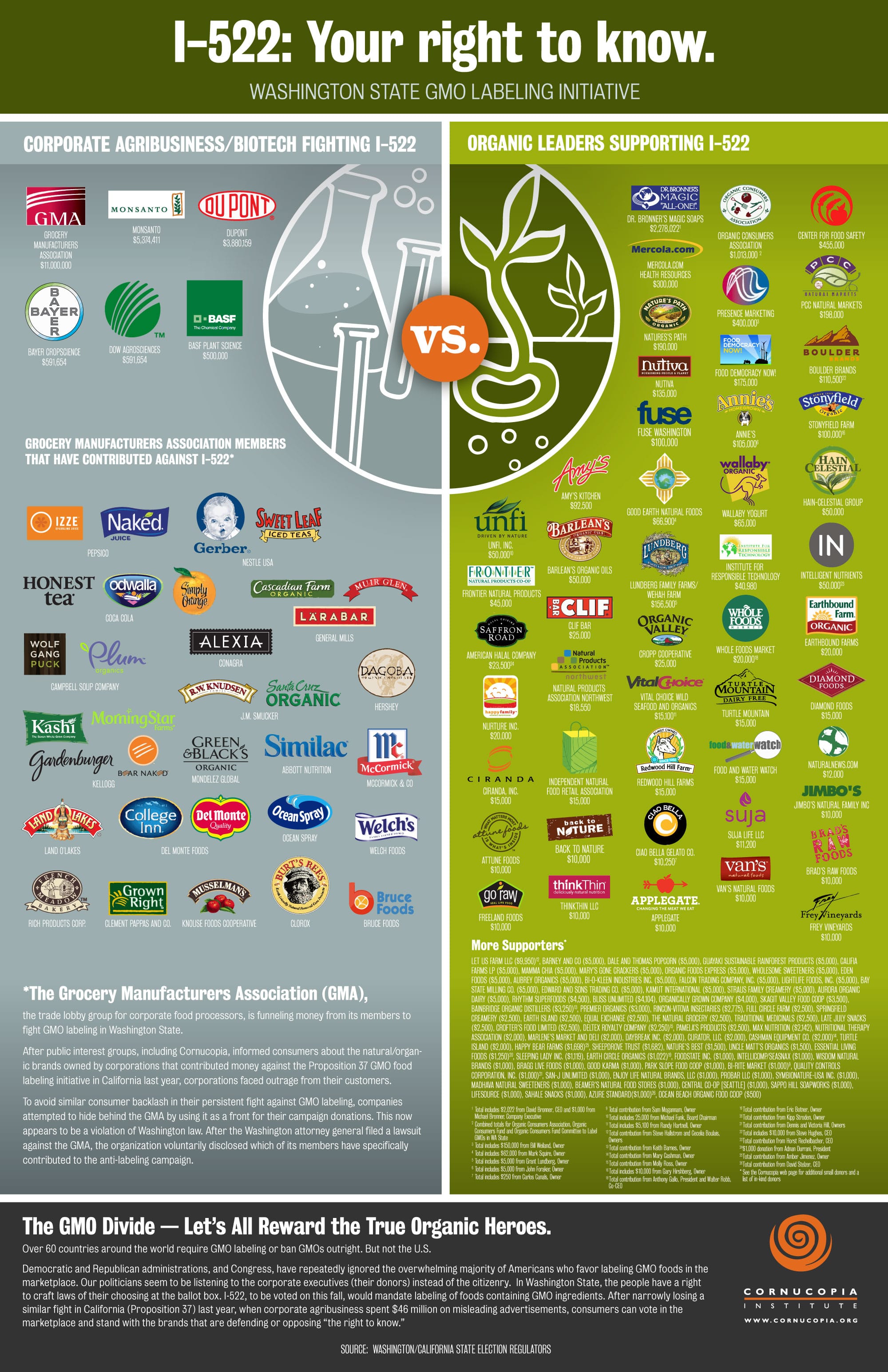
I-522 poster
As always, I encourage you to continue educating yourself about genetically engineered foods, and to share what you've learned with family and friends. Remember, unless a food is certified organic, you can assume it contains GMO ingredients if it contains sugar from sugar beet, soy, or corn, or any of their derivatives.

If you buy processed food, opt for products bearing the USDA 100% Organic label, as organics do not permit GMOs. You can also print out and use the Non-GMO Shopping Guide, created by the Institute for Responsible Technology. Share it with your friends and family, and post it to your social networks. Alternatively, download their free iPhone application, available in the iTunes store. You can find it by searching for ShopNoGMO in the applications.

For more in-depth information, I highly recommend reading the following two books, authored by Jeffrey Smith, the executive director of the Institute for Responsible Technology:
For timely updates, join the Non-GMO Project on Facebook, or follow them on Twitter.

Please, do your homework. Together, we have the power to stop the chemical technology industry from destroying our food supply, the future of our children, and the earth as a whole. All we need is about five percent of American shoppers to simply stop buying genetically engineered foods, and the food industry would have to reconsider their source of ingredients—regardless of whether the products bear an actual GMO label or not.

Link:  http://articles.mercola.com/sites/articles/archive/2014/02/04/roundup-glyphosate-toxicity.aspx?e_cid=20140204Z1_DNL_art_1&utm_source=dnl&utm_medium=email&utm_content=art1&utm_campaign=20140204Z1&et_cid=DM38971&et_rid=417779972.

Tuesday, October 8, 2013

Vandana Shiva on the Problem with Genetically Modified Seeds | Moyers & Company | BillMoyers.com

 July 13, 2012
Source: Moyers and Co.
  
BILL MOYERS: We turn now from one champion of the public interest to another. From Sheila Bair fighting for greater oversight of the big banks to a global advocate for social justice named Vandana Shiva.
VANDANA SHIVA: We need a new paradigm for living on the earth because the old one is clearly not working.
BILL MOYERS: The last time we spoke with her, she was battling Coca-Cola and other multinational giants over the privatization of water in her native India—including the waters of the sacred river Ganges. Since then, Vandana Shiva has become a rock star in the worldwide battle over genetically modified seeds. Those are seeds aggressively marketed around the world by big companies like Monsanto to not only increase, but also to monopolize food production and profits. Opponents challenge their safety, claim they harm the environment, are more costly, and leave local farmers deep in debt and dependent on suppliers.
Following Europe’s example, many American consumers are demanding that food products made from genetically modified seeds be labeled. Monsanto, the world’s largest supplier, claims intellectual property rights over its seeds and usually wins when it takes farmers to court for patent infringement. But in India, Monsanto claimed its seeds would produce bountiful crops and when the results fell short, many bankrupted farmers reportedly killed themselves.
Vandana Shiva, founded India’s Navdanya movement to promote the use of native seeds, and she has become a formidable figure in all these battles. Trained in physics, she’s an activist and prolific author whose books include “Earth Democracy,” “Soil Not Oil,” “Water Wars,” and her latest, “Making Peace With The Earth.” I talked with her again recently, when she came to New York to be honored by Union Theological Seminary.
Welcome back.
VANDANA SHIVA: Wonderful to be back with you.
BILL MOYERS: It's an uphill battle you're waging. How do you keep doing it? What drives you really?
VANDANA SHIVA: You know, we have this very beautiful text in India. We have the Gita.
BILL MOYERS: Bhagavad Gita?
VANDANA SHIVA: The Bhagavad Gita. And there's a very simple lesson that Krishna gives. That you do not measure the fruit of your action. You have to measure your obligation of action. You have to find out what's the right thing to do. That is your duty. Whether you win or lose is not the issue. The obligation to do the right thing, for me, you know, I've grown up as an ecologist in a major level, from my very childhood.
And for me, the diversity of species, their intrinsic value, their integrity is vital. The rights of our farmers to be able to have seed, the most fundamental source of livelihood in a poor country. Eighty percent of the food of the world is even, today, produced by those small farmers of the kind that we have in India. Our small farmers are feeding 1.2 billion Indians. We forget the scale of what smallness means multiplied many times. Because we've got used to the dinosaur mentality. We only see the big. We forget that dinosaurs go extinct.
BILL MOYERS: You have obviously seen things differently. Because you studied nuclear physics, right?
VANDANA SHIVA: I studied nuclear physics. But I also studied quantum theory. My thesis was on non-separability and non-locality in quantum theory.
BILL MOYERS: Which means?
VANDANA SHIVA: Which basically means everything is connected. Because the industrial revolution and the scientific revolution gave us a very mechanistic idea of the universe. First, we were told “Nature is dead. There's no living Earth. How can you even imagine the Earth lives? How can other species-- they're just inferior creatures of God. And you've got to have man's empire over God, over the Earth."
The idea that everything is this hard matter, unrelated to each other is still guiding a lot of science. And genetic engineering is based on that hard matter, genes in isolation, you know? Genes determine everything. There's a master molecule that gives orders. Old patriarchal stuff. The real science--
BILL MOYERS: Patriarchal?
VANDANA SHIVA: The real science is the science of interconnection. Whether it's going to--
BILL MOYERS: Of what?
VANDANA SHIVA: Of interconnectedness, of non-separation. That everything is related.
Farming, for example, you must see the soil, the plants, the pollinators, the food that's produced, all of it in the whole.
BILL MOYERS: Let's take that to the system of economics. Because some people have said that globalization, the movement of ideas, of people, of money, across arbitrary boundaries, as if they didn't exist, also reflects the interconnectedness of everything. That globalization is an economic equivalent of what happens in the world of nature in that everything is connected. And you can't stop it Vandana Shiva. This is the way the world rocks.
VANDANA SHIVA: First of all, this is not interconnectedness of the ecological level. It's an extremely artificial, corporate rule on a planetary scale. Some corporations get to control the world. And then all that's flowing around is commodities. Commodities that don't have to be moving. It's still the old, hard, billiard ball model. You know?
You load the ships from China for cheap consumer products in Wal-Mart here. That is not a world of interconnectedness. The world of interconnectedness would recognize that the rivers of China need to flow, clean and free. It would recognize that the people of China need to exercise in work, in freedom, not as slave labor in factories to produce cheap goods.
This corporate globalization, based on more, higher, a deeper reach of corporations in fields where they had no role, food, water, the air, all into commodities—you know, transforming the Earth into commodities. That flow is not a flow of interconnectedness. And in fact, it is leading to a disconnection. If you look at the violence being perpetuated.
The reason I've written my new book, “Making Peace with the Earth,” is because I'm watching every day. I get calls every day from remote areas. "Please come down. They're shooting us. They're trying to tear down our sacred mountain of Niamgri, which has-- for aluminum. We have an iron ore in our mountains. They're displacing us." Every day there's a land war. Every day there's a water war. Because of the appetite of this global commodity-producing, consumption-based interconnection.
And I often say that what we have is an interconnectedness of the world through greed, which is not how nature works, which is not how humanity works. And an exclusion of people, a killing of their humanity. It is not an accident that with the rise of corporate globalization and economic globalization, we have seen the rise of religious conflict, ethnic conflicts, where people get divided, more and more and more.
So we're seeing human divisions. You're seeing a deeper division between human beings and the Earth. And all you see is a global reach. We are seeing a drop in our sense of a common humanity, and definitely a collapse in the planetary consciousness that we need to have. And for me, those are the two elements of making peace with the Earth. Reclaiming our common humanity and reclaiming our recognition that we are Earth’s citizens.
BILL MOYERS: The last time you were here, you were fighting Coca-Cola in India over the privatization of water. Now your bulls-eye is on Monsanto. Why is Monsanto so crucial to this fight overseas?
VANDANA SHIVA: Monsanto is crucial to this fight because they are the biggest seed company now. Monsanto is privatizing the seed. They control 95 percent of the cotton in India, 90 percent of the soy in this country. They've taken over most of the seed companies of the world.
BILL MOYERS: You say it's all about seeds. And that it comes down to corporations wanting to patent seeds. How does that work? What do you mean it comes down to seeds?
VANDANA SHIVA: Well, it comes down to seeds for the simple reason everything begins a seed. The food on our plate. You and me were seed at one point. The little calf that becomes the cow. Seed is the source of life. And seed is the source of renewal of life. That is where life gets renewed in perpetuity.
BILL MOYERS: So what does it mean when a corporation patents the seed?
VANDANA SHIVA: The first thing it means is a lie. That "I have created it. I have created life."
BILL MOYERS: "I, the corporation."
VANDANA SHIVA: The corporations claim that-- and, you know, we joke and say, a G.M.O., a genetically modified organization, which was the path to get patenting on seeds-- I sat at meetings where the corporations said, "The reason we've got to do genetically modified organisms is because it’s the only way we can claim a patent. A patent is a claim to invention, a claim to creation. And it brings with it an exclusive right to exclude anyone else from using, having, distributing the patented product."
BILL MOYERS: What's the claim? Speak from their side. What are they claiming?
VANDANA SHIVA: Well, they're claiming intellectual property. And they changed the language. They say the seed is no more a seed. It's an intellectual property. They make the society shift its thinking of what is at stake. Seed is the first link in the food chain. And therefore, when you control seed, you control food.
BILL MOYERS: You say that corporations have hijacked our food system. How so?
VANDANA SHIVA: Well I come from a country where there were no corporations in the food system until 20 years ago. They weren't allowed to be. Our rules said food was too precious. It was an important source of livelihood. So we had to protect our small farmers. Every law protected the small farmer, land rights, markets, prices, everything worked so a small farmer could have a living. Food processing stayed in what we call the cottage sector, the small scale sector. That's why we didn't have junk food and processed food. Globalization changes the rules. And agriculture agreement is written by a former official of Cargill to represent the U.S. public.
BILL MOYERS: Cargill--
VANDANA SHIVA: Is the world's biggest grain trader. The second is the intellectual property treaty controlled and written by Monsanto. And then you have the so-called food safety agreement called The Sanitary and Phytosanitary Agreement. Every one of these are very highly complex names. Trade Related Intellectual Property Rights, Sanitary and Phytosanitary. All of them are basically saying, "Let there be a monopoly of a corporation to have-- to write the rules so that only they can be players in the food system."
And the final step is the retail, where food reaches our table, Wal-Mart wanting to have foreign direct investment in retail. A big issue in India's parliament, a very big issue on the streets of India. So from the seed to the table, corporations are saying, "We want to be the only players." Five in seed, five in grain trade, five in processing, and five in retail. That is a corporate hijack of our food and a corporate dictatorship over our food system.
BILL MOYERS: But here’s what you’re up against. Several activist organizations—some seed businesses, some farmers, organizations like yours—filed a suit here in New York, challenging Monsanto's seed patents. And the U.S. district judge here in New York threw it out, saying it was “a transparent effort to create a controversy where none exists.”
VANDANA SHIVA: Yes, that case has been a sad ruling, a very sad ruling. In my view, it's the same kind of status that says corporations have freedom of speech and therefore they can hijack our democracy. Let them spend as much money as they can to literally buy elections. But for every case of this kind, there are other cases being won.
We have won cases against Monsanto in India.
BILL MOYERS: But if something like this is as bad as you describe it. If it's a monster roaming the countryside. How is it getting away with it?
VANDANA SHIVA: Well, it's getting away for two reasons. First, freedom, democracy, and choice is taken away. It's taken away from the farmer, by not allowing them to have their seed. It's taken away from the consumer by not letting them have labeling to say what they're eating. If there was labeling of G.M. foods, no one would eat it.
BILL MOYERS: Genetically modified--
VANDANA SHIVA: Genetically modified foods. The second deeper tragedy, which is why I link this always to democracy, is the fact that governments are being hijacked and governments are being influenced.
We stopped a whole agreement in Nepal by building a movement. Haitian farmers said, "We don't want this stuff." And they took it after the earthquake. The French have said, "We don't want this stuff." And the WikiLeaks show the ambassador saying, "We need retaliation.” This is a seed war. This is a war.
President Bush and our prime minister signed an agreement on agriculture, on the board of which sit Monsanto and Wal-Mart. And they then sit and dictate the policies. That means that much more work for us to reclaim our democracy and our freedom. So they're getting away, because they're using governments to shut down alternatives and push seed against the will of people.
And President Bush is on record in a film called “The World According to Monsanto,” senior President Bush, asking Monsanto, "What do you want us to do?"
MAN 1 in The World According to Monsanto: And I would say quite frankly, we have no complaints about the way the USDA has handled it. They’re going through an orderly process. They’re making sure as they deal with these new things they do them properly. No, uh, if we’re waiting until September and if we don’t have our authorization we may say something different.
VICE PRESIDENT GEORGE BUSH SR. in The World According to Monsanto: Call me. We’re in the dereg business. Maybe we can help.
VANDANA SHIVA: In India, Monsanto, in effect, controls our agricultural ministry and our prime minister's office. And so very, very often, we have to work very closely with our state governments, which are our regional governments, to defend our constitutional rights.
To say, "Why should we be force fed a genetically engineered B.T. eggplant, when we have the most delicious eggplants, 4,000 varieties?" It took a movement, 13 governments, 7 public hearings to put a moratorium. The advisors from here flew in to try and undo that moratorium.
BILL MOYERS: Monsanto advisors?
VANDANA SHIVA: U.S. Government advisors.
BILL MOYERS: On the side of Monsanto?
VANDANA SHIVA: On the side--the White House, the USDA--
BILL MOYERS: Department of Agriculture?
VANDANA SHIVA: And the Department of Agriculture and the FDA all have a revolving door with Monsanto. And this is all on record. So on the top, there's Monsanto, hijacking all our governments. And through that, trying to hijack our food supply. And from the ground, farmers, consumers, regional governments saying, "We want a Monsanto-free food system. We want Monsanto-free, G.M.O.-free, patent-free seed."
BILL MOYERS: Now Vandana, the other side of the argument is made by people like Bill Gates. Bill Gates says that genetically modified seeds are necessary to prevent starvation in poor countries because they enable farmers to double and triple their productivity.
VANDANA SHIVA: Unfortunately, he's so totally wrong on this assumption that genetically modified seeds produce more. In India, Monsanto came in with a claim of 1,500 kilograms of cotton per acre with their genetically engineered cotton. The average yields are 400 kilograms. Our studies show that. The government studies confirm this.
When you grow just genetically modified cotton, you destroy all the associate crops that were feeding the poor families. So it actually leads to less food. When you spray roundup and kill the greens that are necessary for women to have iron, for children to have vitamin A, you're creating hunger. You're creating disease.
Super weeds taking over your fields are a recipe for hunger. Pests overtaking your fields are a recipe for hunger. But worse, seed, patents are a way of getting money out of poor people. This is not a solution to hunger and poverty. This is aggravating the crisis poor people already face.
BILL MOYERS: You know, many people will hear you as they have the others who come on this, at the table and describe what's going wrong in the world. And they always-- they often write me on the web or stop me on the street and say, I heard that diagnosis. But what can I do?
VANDANA SHIVA: I think first thing is each of us has to daily ask a question, "Where am I complicit in a war against the Earth? Where are my daily actions part of a devastation of the planet and with it, a devastation of the lives of people." Because the two go hand in hand. A war against the Earth is a war against people. Peace with the Earth is peace among people.
Getting rid of the inequalities, the violence, the exclusions. And I realize that food is a place where we can all begin. Food is a place which is so loaded with dishonesty and is what keeps a false economy of food alive. The subsidies that go to industrial agriculture.
BILL MOYERS: Subsidies we taxpayers--
VANDANA SHIVA: Taxpayers pay. A high-cost system, which uses a lot of wealth of society, then uses our wealth to cheat on the prices and make costly food look cheap. So our choices are distorted. We go and eat the junk food that then creates the high cost of disease, the high cost of obesity, the high cost of diabetes at an early stage, the high cost of environmental devastation.
And so we need an honest system. And we can begin by creating that honesty and that peace by relating more directly to the food we eat, to the people who grow our food.
To me, the beauty is, every time I come back to this country, there are more farmer's markets. There is more commitment to local food supply. Even in the city of New York, people are saying, "We'll make local food. We'll grow local food." It is an easy step, but it is a very far-reaching step.
BILL MOYERS: You’ve spent time in this country, you know that in inner cities it’s almost impossible to buy fresh fruits and fresh vegetables.
VANDANA SHIVA: That's the challenge we have. It's not that there isn't a food stamp system. Public money is being spent on feeding the poor. But then it's insuring that the only access the poor have with the money they get, again from public money, is to bad food. We could divert this to good food. There's no rule in the book that says healthy food should be a luxury for the rich. Healthy food is a right for all.
BILL MOYERS: For the last 20 years, we've heard and read report after report of progress in India, the creation of a middleclass enjoying its new prosperity. At the same time, we read and hear and see stories of people deprived of their livelihood and their homes from huge environmental projects, big dams, big mines, big infrastructure. I mean, it's always been a lot of poverty there. But are you becoming-- is that great gulf becoming a permanent feature of India in this modern world?
VANDANA SHIVA: Well, you know, my small effort is to not allow it to become a permanent feature. But it's not that these are two separate worlds. They're separated in terms of the status of people, their dignity, their rights. But they are deeply connected at the levels of the Earth's resources.
The reason you have a few families joining the ten richest billionaires of the world in the Forbes list is because they've grabbed the land, the electricity, the resources, the oil, and that is what has left the other India poorer. It wasn't that the other India was left out. They've been pushed out. And that's why while we have some of the highest growth rates in the conventional measure of economic progress, which in my view is not a very reliable measure, we also have two of the most outrageous indicators that are linked to that model. The first is the quarter million farm suicides. If a quarter million farm--
BILL MOYERS: Those have been documented?
VANDANA SHIVA: They're documented. This is Government of India data. This is not our data. It's official statistics. And you can do an overlay. And the highest rates of suicides are in the cotton belt, 95 percent of the cotton today is Monsanto's cotton. So there is a link.
Today ever fourth Indian is hungry and every second Indian child is wasted or stunted, which in effect means that half of India is being robbed of its future. And to me, this is not acceptable. That is why we try and build a kind of agriculture that allows farmers to have a livelihood, for the poorest child or the poorest household to have nutritious food. It is not easy because the whole system is weighed against alternatives that would work for everyone.
It's partly because of the pressure of the corporations, but partly because of not thinking, of just being blind, of having been so fed by what I have called monocultures of the mind, you know, just turning to recipes from somewhere else. And of course the chemical industry will tell you only chemicals grow food. Chemicals grow toxics. Chemicals don't grow food.
That only Monsanto seeds will be able to remove hunger. And all of this new mythology becomes part of the policy framework. But I am deeply committed to make sure that this terrible brainwashing that is robbing our present generation and our future generations, that we are able to work collectively to change it. Because while in your parents’ generation, your generation, and in my generation, the doors of a growing economy were constantly opening up, today we are in a period, where for the majority, the doors are shutting down.
I work with people in Spain, with people in Italy. I advise the governments there, work with the movements there, or Greece, or the Occupy movement right here. They are realizing that what has been created is not going to provide opportunities for all.
BILL MOYERS: As you talk, I remember reading somewhere that Einstein had a big influence on you, right?
VANDANA SHIVA: Yes, I became a physicist because of him. I mean, you know, even as children, you get to, you know, if you read Nightingale, you want to be a doctor or a nurse. I read stuff Einstein wrote and he wrote simple stuff that you could read it. That's why I wanted to be a physicist.
BILL MOYERS: And he said once, I'm paraphrasing it, but "Unless an idea is at first absurd, it has no chance of success."
VANDANA SHIVA: Absolutely. He also said that you cannot solve the problems you face through the same mindset that caused those problems.
BILL MOYERS: Vandana Shiva, thank you very much for being with me again.
VANDANA SHIVA: Thank you, Bill. It's always such a pleasure.


Vandana Shiva on the Problem with Genetically Modified Seeds | Moyers & Company | BillMoyers.com

Sunday, February 10, 2013

What countries have banned GMO crops?

Intro: This is an excellent article about GMO crops. I copied it onto this blog, and gave the sources and the credit to the author. Recently the author has written to me through the comment section and requested that I write an intro to it and give the link to the original article. The purpose of my copying it to this blog was to spread the information as much as I could to the general public. I appreciate the work that the author is doing and do not find any reason to not accept her request. Therefore I encourage anyone who is interested in this subject to go to the original article in examiner.com.  The link to the original article is: http://www.examiner.com/article/what-countries-have-banned-gmo-crops.

Tuesday, September 11, 2012

Vermont Introduces Monumental GMO Labeling Legislation

February 8, 2012
Anthony Gucciardi
Source:NaturalSociety

Vermont has taken the initiative against Monsanto and other biotechnology corporations in launching new legislation that would require the labeling of products containing genetically modified ingredients. The bill, known as the ‘VT Right to Know Genetically Engineered Food Act’, was introduced to the Vermont House of Representatives by Representative Kate Webb of Shelburne on February 1st, 2012. The bill would require the labeling of not only products filled entirely with GMOs, but also for those partially created using GM ingredients.

Perhaps most monumental is the fact that the legislation would prohibit GMO food manufacturers from using promotional labels like “natural,” “naturally made,” “naturally grown,” “all natural,” or any words of similar import. The bill, which can be read for free online, would require strict and clear labeling on GMO-containing food items. The wording states that in the case of a raw agricultural commodity, the label ‘genetically modified’ would be clearly visible. As for processed food products, the words ‘partially produced with genetic engineering’ or ‘may be partially produced with genetic engineering’ would appear prominently on the front or back of the package.

Referred to the House Committee on Agriculture , testimony is to begin on the topic later this month.

The introduction of the legislation highlights the growing grassroots opposition against Monsanto and GMOs alike. In addition, the legislation would end phony ‘all natural’ product claims when in actuality they contain very unnatural genetically modified organisms. Just recently one consumer took legal action against major snack-maker Frito-Lay, claiming that the labeling of GMO-filled snack products as ‘all natural’ is deceptive and misleading.

VPIRG Consumer Protection Advocate Falko Schilling spoke in support of the act saying “This is a consumer right to know issue, just as we require nutritional labels on food so that shoppers can make informed choices, consumers should have the same access to information about whether their food has been genetically engineered.”

In the event this bill passes, a political awakening could occur across the nation regarding the true labeling of products filled with genetically modified ingredients.

Bill Gates Foundation Buys 500,000 Shares of Monsanto

August 30, 2010
Anthony Gucciardi
Source:NaturalSociety

Monsanto has already negatively impacted agriculture in African countries. For example, in South Africa in 2009, Monsanto’s genetically modified maize failed to produce kernels and hundreds of farmers were devastated. According to Mariam Mayet, environmental attorney and director of the Africa Centre for Biosafety in Johannesburg, some farmers suffered up to an 80% crop failure. While Monsanto compensated the large-scale farmers to whom it directly sold the faulty product, it gave nothing to the small-scale farmers to whom it had handed out free sachets of seeds. “When the economic power of Gates is coupled with the irresponsibility of Monsanto, the outlook for African smallholders is not very promising,” said Mayet.

Monsanto’s aggressive patenting practices have also monopolized control over seed in ways that deny farmers control over their own harvest, going so far as to sue-and bankrupt-farmers for “patent infringement.” Monsanto was declared company of the year by Forbes magazine in 2009, despite its history of agricultural abuses. Monsanto has also been accused of dumping toxic waste in residential areas, resulting in a variety of severe health disorders.


Sunday, August 26, 2012

We have until the end of August to tell the EU we don’t want GM animals in our countryside

August 18, 2012
Source:The Therapy Book

This consultation from Brussels seeking public approval for introducing GM animals into European countrysides has been quietly put out, no doubt in the hope that most of us will be so entranced by the Olympics, we won’t see it. However, we now have until the end of August to respond to it.

European consultation on GM animals

The European Food Safety Authority (EFSA) has issued a consultation on environmental risk assessment of genetically modified GM fish, insects, birds, and mammals (including pets, wild and farm animals) in the European Union (EU).

This consultation is intended to pave the way for the introduction of many different types of GM animals into the European countryside, rivers or seas, their use in factory farming, and even their introduction as pets into people’s homes.

If you are concerned about this, see the “what you can do” section on this page.

EFSA’s remit is to assess risks in the food chain, it therefore has no competence to assess the impacts on other species of releasing these GM animals into the environment.
What is included in the EFSA consultation?

The consultation includes:

GM fish. The section on GM fish is designed to facilitate the introduction of GM salmon produced by the company Aquabounty. There are major concerns that these fish could damage wild salmon populations if they escape into the environment. Other GM fish species are expected to be introduced if GM salmon is approved.
GM insects.The section of the consultation on GM insects has been heavily influenced by the UK company Oxitec, which is developing genetically modified mosquitoes and agricultural pests, with funding from the Swiss multinational agricultural company Syngenta. Oxitec has a patent which lists more than 50 species of insect it wishes to genetically modify and release into the environment. Syngenta wants to market GM insects for use by farmers in Europe and worldwide: one of the main proposed applications is to combine them with GM pest-resistant crops (Bt crops) to try to slow the spread of resistance to these crops. In the longer term potential commercial applications include pesticide-resistant bees.
GM birds. GM chickens are being developed which are supposed to slow the spread of bird flu in factory farms. These birds raise many concerns, including the possibility that they will make the risk of bird flu worse.
GM mammals. The consultation also covers GM mammals, including farm animals such as cows, pets such as cats, and wild animals such as rabbits, all of which could cause harm if they are released or escape into the environment. Products from some of these animals, such as milk from GM cows, may end up in the food chain. Genetically modifying mammals often causes suffering because many attempts fail resulting in aborted fetuses or stillbirths.

You can read more about some of these applications elsewhere on this website: GM fish, GM insects and GM and cloned animals. GeneWatch will add a copy of its response to the EFSA consultation here, when it is completed.
What you can do

There are five things you can do if you are concerned about the proposals in the EFSA consultation:

Contact your MP
Contact your MEPs
Respond to the consultation (by end August 2012)
Contact your local supermarkets
Let other people know.

Contacting your MP and MEPs

You can contact your MP and members of the European Parliament (MEPs) if you are concerned about the EFSA consultation and proposals to introduce GM fish, insects, birds, farm animals and pets into the air, land and sea in Britain.

Things you could point out to them include:

The European Food Safety Authority (EFSA) does not have the remit or competence to assess environmental harms should any of these GM animals be released or escape into the British countryside or seas.
The consultation ignores the problems there will be keeping a GM-free food supply if these proposals go ahead. There are no plans in the consultation to trace where GM fish or cattle eggs or sperm will end up, or to prevent GM caterpillar eggs from entering the food supply on cabbages or other crops.

The most effective thing to do is to ring your MP’s constituency office and ask to make an appointment to see him or her, but you can also write a letter or send an email. Contacting your MEPs is important too because the European Parliament should have a say about EFSA’s work.

You can find your MP on the They Work for You website or on the UK Parliament website. You can also email your MP and your MEPs directly from the Write to Them website.
Responding to the consultation

The deadline for responses to the EFSA consultation is 31st August 2012.

The EFSA consultation is very poorly written. For example, what is covered and some definitions are different in each section (for fish, insects and mammals and birds) and the structure of the report assumes it is possible to separate the effects of a GM animal on one species from another, as if multiple species did not interact in the environment. Many scientific references are missing.

If you want to comment on the consultation you can only do this online on the EFSA website here and you must make short comments line by line.

However, you do not have to submit comments on the whole document. If you want to make only one comment you could comment on the Background lines 165 to 168, by pointing out that EFSA is not competent to assess environmental risks as it has no remit or expertise in this area.
Contacting your local supermarkets or other food shops

You can write to, email or phone your local supermarkets, or call in and ask to see the manager. Things you can ask them are:

What is their policy on selling GM foods?
What is their policy on selling meat, milk or dairy products from animals fed on GM feed?
What is their policy on selling meat, milk or dairy products from GM animals, such as chicken and cows, if these products enter Britain in the future?
What is their policy on selling vegetables, fruit or other crops which may contain GM insect eggs or caterpillers, should GM insects be used in British agriculture in the future?

Your local food shops might also appreciate being told about what is going on.
Letting other people know

Please share this article to your Facebook page or Twitter feed or any other social networking site, and email it your friends.

Brazil court supports consumers’ resistance to GMO in food items

24/08/2012
Source: moneylife

“It appears another victory has been declared in the battle against Monsanto and GMO ingredients,” comments Nation of Change

A Brazilian court has demanded that multi-billion dollar food giant Nestle label all of its products as genetically modified that have over 1% GMO (genetically modified organisms) content. The ruling reportedly coincides with Brazilian law which demands all food manufacturers alert consumers to the presence of GMOs within their products. This has been reported by Anthony Gucciardi, Nation of Change, which is a non-profit organisation with the motto of progressive journalism for positive action.

Mr Gucciardi reports that instead of grovelling to Brazilian officials and mega biotechnology groups, the Brazilian business wire reports that the court determined the Brazilian government to be illegally working with the food industry entity known as ABIA. Furthermore, the court stated that consumers have the basic right to know what they are putting into their mouths especially when it comes to GMO ingredients.

“It appears another victory has been declared in the battle against Monsanto and GMO ingredients,” comments Anthony Gucciardi, Nation of Change. This confirms the long-standing consumers’ resistance and that of activists to GM ingredients in food in India and abroad, the latest being Brazil.

The Brazilian court issued a fine of $2,478 per product that was found to violate the ruling after finding the presence of GMO ingredients in Nestle’s strawberry Bono cookies, according to Nation of Change.

The injunction also requires that the information on the label must contain the graphic sign designating GM food (a ‘T’ in lowercase, inserted in a triangle with yellow background), accompanied by the term ‘transgenic’, as reported by Jornal DCI, Sao Paulo. The injunction was given in the civil action filed by the Public Prosecutor of Sao Paulo (SP-MP). The analysis found genetically modified products in the composition of ‘Bono’ cookies, strawberry flavour, manufactured and marketed by Nestle. Although more than half of the soyabean used in manufacturing the biscuit are transgenic, this is not declared on the product packaging, as was determined in the civil investigation.

According to Natural Society, where the same activist has written a year ago, in an act of defiance against bloated biotech companies like Monsanto, Peru has officially passed a law banning genetically modified ingredients within the nation for a period of 10 years. Peru’s Plenary Session of the Congress made the decision despite previous governmental pushes for GM legalization. Anibal Huerta, President of Peru’s Agrarian Commission, said the ban was needed to prevent the danger that can arise from the use of biotechnology.

While writing in Natural Society, earlier this year, Mr Gucciardi has commented that in the United States, the government continues to ignore and deny the concerns surrounding genetically modified crops and ingredients, instead streamlining the approval process for Monsanto’s new modified creations.

The safety of GMOs in the food chain has been questioned by environmental groups, with concerns such as the possibilities that GMOs could introduce new allergens into foods, or contribute to the spread of antibiotic resistance. The battle against genetically modified seed companies like Monsanto is continuing and is watched by avid journalists and activists alike.

Saturday, May 26, 2012

Opting for This "Cheaper Food" Could Make You Age Faster

May 26 2012
By Dr.Mercola

Twenty years ago today, former Monsanto lawyer and present FDA deputy commissioner Michael Taylor declared genetically engineered foods "substantially equivalent" and declared they would not need to be labeled for consumers.

Today is also the last day of the Money Bomb Against Monsanto Campaign, which launched on May 1. Earlier this month, volunteers and staff from the California Right to Know Campaign submitted nearly 1 million signed petitions from registered voters across the state of California to county officials, to place Right to Know Genetically Engineered Food Act on the Ballot for November 6.

This Act will require food manufacturers to identify genetically engineered ingredients on the labels of foods sold in California.

When California voters pass this ballot initiative, the Label Genetically Engineered Food Act will also not allow the common practice of mislabeling genetically engineered foods as "natural" or "all natural." But the biotech industry is not about to let this pass without a fight.

Industry Propaganda Aimed at Confusing and Misleading Consumers

The Council for Biotechnology and the Grocery Manufacturers Association have filed as formal opposition to this initiative. Not surprisingly, Monsanto is a member of both groups.

Big Biotech and major processed food manufacturers are pooling tens of millions of dollars together to spread their propaganda in an effort to defeat the California Ballot Initiative. In a recent Organic Consumers Association article, Alexis Baden-Mayer, Esq., Political Director of the Organic Consumers Fund writesi:

"Kathy Fairbanks, spokeswoman with the Coalition Against the Costly Food Labeling Proposition, says requiring labels on genetically engineered food would increase food prices.

What she doesn't say is that she's being paid by the trade association that represents both the biotech behemoths like Monsanto that engineer the GMO crops and the food industry giants like PepsiCo that use ingredients made from these crops in their products. PepsiCo., Kraft, Kellogg's and other top food processors market so-called "natural" protects at a premium that rivals what consumers pay for non-GMO and organic foods - even though these so-called "natural" foods contain unlabeled GMOs. The money these companies swindle from us as they trick us into paying top-dollar for GMO foods disguised as "natural" dwarfs the miniscule 0.01% of food costs attributable to GMO labels...

Maryann Marino, Southern California regional director of California Citizens Against Lawsuit Abuse says GMO labels will make family farmers and small businesses vulnerable to lawsuits.

Her organization is a state chapter of the American Tort Reform Association (funded by Monsanto) which thinks it's okay for Monsanto to sue farmers in 143 different patent infringement lawsuits when their crops are unintentionally contaminated with Monsanto's GMOs, but it isn't okay for farmers to get together and bring one lawsuit against Monsanto to stop the harassment. Think they really care about family farmers or small businesses? Their only interests are protecting Monsanto's market share and helping companies sneak Monsanto's ingredients into their products without letting consumers know."

Why Labeling Genetically Engineered Foods Will Not Significantly Raise Prices

Baden-Mayer also explains why you shouldn't fall for such fear-mongering, as these scenarios have little if any bearing in factual truth. She writes:

"A 2002 Oregon State University study reviewed the true costs of actual laws requiring labels on genetically engineered food in other countries. According to the study, a law in the UK, like the one proposed for CA, increased food spending by only 0.01%. The most any GMO labeling proposal was projected to cost was 1.8%. (This was from a Canadian study where, the authors note, the costs of segregating crops, changing processing procedures and changing the label were exaggerated and came only from expectations expressed by industry spokespersons.)

The 0.01% to 1.8% increase in the cost of labeling GMO foods must be put in perspective by looking at what companies already spend and consumers currently pay to avoid genetically engineered ingredients. A 2005 University of Delaware study showed that consumers would pay 20-30% more for non-GMO or organicii.

The so-called "natural" food industry has taken full advantage of consumer interest in avoiding GMOs and consumer ignorance in where those GMOs may be lurking. A review by the Cornucopia Institute of "natural," non-GMO and organic cereals showed that so-called "natural" cereals that contained unlabeled GMOs were sometimes more expensive than real non-GMO and organic cerealsiii.

Once GMOs are labeled, consumers will easily be able to substitute products that contain non-GMO cane sugar for products made with GMO sugar beet sugar or high-fructose corn syrup and change from vegetable oils made from GMO canola to non-GMO sunflower or olive oil. They'll be able to eat more non-GMO wheat and rice and less GMO corn and soy. They can choose non-GMO fruits and vegetables and avoid the few that are GMO. Eating non-GMO won't involve paying a premium, just making a choice between the foods that are genetically engineered and the ones that aren't. Foods that are GMO won't be able to be falsely labeled as "natural."

Why GE Labeling Will Not Open Up Farmers and Small Businesses to Lawsuits

The claim that farmers and grocers may become more vulnerable to lawsuits as a result of the Right to Know Genetically Engineered Food Act is also false and nothing but a scare tactic.

Why?

First of all, farmers and grocery stores are not responsible for listing ingredients on food labels. The only way a grocer could get into trouble would be if they knowingly mislabel their own store-brand product. They cannot be held liable if a food processor or food packer fails to comply with the labeling law.

The language in the Act is also very clear—it only requires labeling of foods that contain genetically engineered ingredients. Each new genetically engineered crop must be deregulated by the US Department of Agriculture (USDA), which makes them easy to track. Once deregulated, farmers clearly know whether their crop is genetically engineered or not since they are required to purchase expensive patented seeds that are clearly branded and marketed as genetically engineered by the seed companies. So when they sell their crops to a food manufacturer, there's no question whether they're dealing with a GE ingredient or not.

Furthermore, under the proposed law, foods containing genetically engineered ingredients cannot be labeled as "natural." Food packers and processors are given 18 months to comply with the new labeling requirements—which is the typical timeframe within which labels are routinely updated anyway—so complying with the new regulations should not be a major problem. Baden-Mayer also points out that:

"Food packers and processors may decide to seek non-GMO sources to avoid the law's labeling requirements, and that may increase markets for farmers who grow non-GMO crops, but that is a different issue than simply complying with a new labeling requirement." And, "If PepsiCo continues to sell unlabeled genetically engineered food in CA once this law is passed, we'll definitely sue them (we'd rather see them comply), but this law creates no incentive to go after small businesses."

The Future of Your Food is at Stake

Although The Future of Food is five years old, this excellent film is more relevant now than ever. If you haven't watched it, please set aside some time to see it. It's required viewing for anyone who wants to understand what they're putting into their belly. If it's been awhile since you saw it, you may want to refresh your memory.

"This is a Flash based video and may not be viewable on mobile devices."
The Time for Action is NOW!

We need to send the biotech and food industry a clear message: We have the right to know what they put into our food!

Can we win? Yes, I believe we can! But we need to get the word out, which requires a strong campaign to educate the citizens of California to vote for the initiative on November 6. If you missed my recent panel interview with Ronnie Cummins with the Organic Consumers Association, Pamm Larry, founder of LabelGMOs.org and Dave Murphy, founder of Food Democracy Now, in which we discuss the California Right to Know Campaign, please take a moment to listen to it now.

According to Ronnie Cummins of the Organic Consumers Association, we stand a good chance of winning in California because:

This time, we have far more scientific information and greater public awareness on our side. GE contamination is now a mainstream media issue. Monsanto has become the most hated corporation in the world.
This time, we have overwhelming public support. Polls show that more than 8 out of 10 voters in California want mandatory GE labeling.
This time, we have built the strongest coalition of concerned food consumers in history, for the exclusive purpose of passing this law.

So today, I ask you to invest in this Initiative. Invest in your future. And invest as generously as you can. If you've already sent in your donation, thank you! If not, please contribute to this historic and critical campaign today. And then please forward this email to your friends. Share it on Facebook and Twitter. Print it out, hand it to all your friends. Every action counts! As stated by Ronnie Cummins with the Organic Consumers Association:

"Monsanto is one of the most powerful, arrogant and destructive companies in the world. For decades, they have controlled the world's food supply by buying off politicians and regulatory agencies, intimidating small farmers, manipulating the outcome of scientific studies, lying to consumers - and threatening to sue states like Vermont if they dare to pass a GMO labeling law.

... Despite Monsanto's claims to the contrary, scientists are clear: genetically engineered food has been linked to a wide range of health hazards, including kidney and liver damage, infertility, auto-immune disorders, allergies and autism, accelerated aging, and birth defects... We have the right to know if the food we buy has been genetically engineered.... It's time to take back our food. Our farms. Our power. It's time to show Monsanto what ordinary people like us can do when we come together."

Hundreds of thousands of people making small donations can help the coalition behind this initiative run a dynamic, effective campaign to bring down Monsanto and the rest of the Biotech Bullies

Now it's time to organize, educate, and promote this cause. We won't need to spend the tens of millions that the biotech bullies are using to fight this initiative - but we will need several million to combat their propoganda adequately.

So please, join us, and make a donation right now! You can donate online, by phone, or by dropping a check in the mail.

References:

i Organic Consumers Association May 5, 2012
ii Department of Food and Resource Economics University of Delaware, Experimental Investigation of Willingness to Pay for Non-GM and Organic Food Products, Katie Gifford, John C. Bernard, Ulrich C. Toensmeyer, Richard Bacon, Department of Food and Resource Economics University of Delaware
iii Cornucopia Institute, Cereal Crimes 2011 Report

Monday, February 6, 2012

The seed emergency: The threat to food and democracy

written by:Dr Vandana Shiva
Source: AlJazeera

New Delhi, India - The seed is the first link in the food chain - and seed sovereignty is the foundation of food sovereignty. If farmers do not have their own seeds or access to open pollinated varieties that they can save, improve and exchange, they have no seed sovereignty - and consequently no food sovereignty.

The deepening agrarian and food crisis has its roots in changes in the seed supply system, and the erosion of seed diversity and seed sovereignty.

Seed sovereignty includes the farmer's rights to save, breed and exchange seeds, to have access to diverse open source seeds which can be saved - and which are not patented, genetically modified, owned or controlled by emerging seed giants. It is based on reclaiming seeds and biodiversity as commons and public good.


The past twenty years have seen a very rapid erosion of seed diversity and seed sovereignty, and the concentration of the control over seeds by a very small number of giant corporations. In 1995, when the UN organised the Plant Genetic Resources Conference in Leipzig, it was reported that 75 per cent of all agricultural biodiversity had disappeared because of the introduction of "modern" varieties, which are always cultivated as monocultures. Since then, the erosion has accelerated.

The introduction of the Trade Related Intellectual Property Rights Agreement of the World Trade Organisation has accelerated the spread of genetically engineered seeds - which can be patented - and for which royalties can be collected. Navdanya was started in response to the introduction of these patents on seeds in the General Agreement on Tariffs and Trade - a forerunner to the WTO - about which a Monsanto representative later stated: "In drafting these agreements, we were the patient, diagnostician [and] physician all in one." Corporations defined a problem - and for them the problem was farmers saving seeds. They offered a solution, and the solution was to make it illegal for farmers to save seed - by introducing patents and intellectual property rights [PDF] on those very seeds. As a result, acreage under GM corn, soya, canola, cotton has increased dramatically.

Threats to seed sovereignty

Besides displacing and destroying diversity, patented GMO seeds are also undermining seed sovereignty. Across the world, new seed laws are being introduced which enforce compulsory registration of seeds, thus making it impossible for small farmers to grow their own diversity, and forcing them into dependency on giant seed corporations. Corporations are also patenting climate resilient seeds evolved by farmers - thus robbing farmers of using their own seeds and knowledge for climate adaptation.

Another threat to seed sovereignty is genetic contamination. India has lost its cotton seeds because of contamination from Bt Cotton - a strain engineered to contain the pesticide Bacillus thuringiensis bacterium. Canada has lost its canola seed because of contamination from Roundup Ready canola. And Mexico has lost its corn due to contamination from Bt Cotton.

After contamination, biotech seed corporations sue farmers with patent infringement cases, as happened in the case of Percy Schmeiser. That is why more than 80 groups came together and filed a case to prevent Monsanto from suing farmers whose seed had been contaminated.

As a farmer's seed supply is eroded, and farmers become dependent on patented GMO seed, the result is debt. India, the home of cotton, has lost its cotton seed diversity and cotton seed sovereignty. Some 95 per cent of the country's cotton seed is now controlled by Monsanto - and the debt trap created by being forced to buy seed every year - with royalty payments - has pushed hundreds of thousands of farmers to suicide; of the 250,000 farmer suicides, the majority are in the cotton belt.

Seeding control

Even as the disappearance of biodiversity and seed sovereignty creates a major crisis for agriculture and food security, corporations are pushing governments to use public money to destroy the public seed supply and replace it with unreliable non-renewable, patented seed - which must be bought each and every year.
Inside Story: Averting a world food crisis

In Europe, the 1994 regulation for protection of plant varieties forces farmers to make a "compulsory voluntary contribution" to seed companies. The terms themselves are contradictory. What is compulsory cannot be voluntary.

In France, a law was passed in November 2011, which makes royalty payments compulsory. As Agriculture Minister Bruna Le Marie stated: "Seeds can be longer be royalty free, as is currently the case." Of the 5,000 or so cultivated plant varieties, 600 are protected by certificate in France, and these account for 99 per cent of the varieties grown by farmers.

The "compulsory voluntary contribution", in other words a royalty, is justified on grounds that "a fee is paid to certificate holders [seed companies] to sustain funding of research and efforts to improve genetic resources".

Monsanto pirates biodiversity and genetic resources from farming communities, as it did in the case of a wheat biopiracy case fought by Navdanya with Greenpeace, and climate resilient crops and brinjal (also known as aubergine or eggplant) varieties for Bt Brinjal. As Monsanto states, "it draws from a collection of germ-plasm that is unparalleled in history" and "mines the diversity in this genetic library to develop elite seeds faster than ever before".

In effect, what is taking place is the enclosure of the genetic commons of our biodiversity and the intellectual commons of public breeding by farming communities and public institutions. And the GMO seeds Monsanto is offering are failing. This is not "improvement" of genetic resources, but degradation. This is not innovation but piracy.

For example, the Alliance for a Green Revolution in Africa (AGRA) - being pushed by the Gates Foundation - is a major assault on Africa's seed sovereignty.

Agribusiness

The 2009 US Global Food Security Act [PDF] also called the Lugar-Casey Act [PDF], "A bill to authorise appropriations for fiscal years 2010 through 2014 to provide assistance to foreign countries to promote food security, to stimulate rural economies, and to improve emergency response to food crisis, to amend the Foreign Assistance Act of 1961 and for other purposes".

The amendment to the Foreign Assistance Act would "include research on bio-technological advances appropriate to local ecological conditions, including genetically modified technology". The $ 7.7bn that goes with the bill would go to benefit Monsanto to push GM seeds.

An article in Forbes, titled "Why Uncle Sam Supports Franken Foods", shows how agribusiness is the only sector in which US has a positive trade balance. Hence the push for GMOs - because they bring royalties to the US. However, royalties for Monsanto are based on debt, suicidal farmers and the disappearance of biodiversity worldwide.

Under the US Global Food Security Act, Nepal signed an agreement with USAID and Monsanto. This led to massive protests across the country. India was forced to allow patents on seeds through the first dispute brought by the US against India in the WTO. Since 2004, India has also been trying to introduce a Seed Act which would require farmers to register their own seeds and take licenses. This in effect would force farmers from using their indigenous seed varieties. By creating a Seed Satyagraha - a non-cooperation movement in Gandhi's footsteps, handing over hundreds of thousands of signatures to the prime minister, and working with parliament - we have so far prevented the Seed Law from being introduced.

India has signed a US-India Knowledge Initiative in Agriculture, with Monsanto on the Board. Individual states are also being pressured to sign agreements with Monsanto. One example is the Monsanto-Rajasthan Memorandum of Understanding, under which Monsanto would get intellectual property rights to all genetic resources, and to carry out research on indigenous seeds. It took a campaign by Navdanya and a "Monsanto Quit India" Bija Yatra ["seed pilgrimage"] to force the government of Rajasthan to cancel the MOU.

This asymmetric pressure of Monsanto on the US government, and the joint pressure of both on the governments across the world, is a major threat to the future of seeds, the future of food and the future of democracy.

Dr Vandana Shiva is a physicist, eco-feminist, philosopher, activist and author of more than 20 books and 500 papers. She is the founder of the Research Foundation for Science, Technology and Ecology, and has campaigned for biodiversity, conservation and farmers' rights, winning the Right Livelihood Award [Alternative Nobel Prize] in 1993.

Sunday, July 17, 2011

Monsanto's Leading Soldier in the War on Raw Milk

June 24, 2011
Brandon Turbeville
Activist Post

In recent months there have been many articles dealing with the intensification of the war on milk launched by the FDA. (See here and here. Also here.) I myself, have written articles explaining the dangers of corporate control of the dairy industry and the specific health concerns related to the use of antibiotics and rBGH in the production of milk.

In my book, Codex Alimentarius – The End of Health Freedom, I detail these health problems as well as the events surrounding the FDA’s compliance with Monsanto’s wishes regarding the use of rBGH in dairy products. Of course, governmental compliance with corporate wishes is not surprising considering the fact that the ranks of the FDA are filled with former Monsanto employees and affiliates and that there exists a virtual revolving door between the agency and the corporation. Nevertheless, if one wishes to get an idea of the role Monsanto plays in the decisions regarding our food supply, Marie Monique-Robin’s documentary The World According to Monsanto is an excellent place to start. So is Jeffrey Smith’s book Seeds of Deception. The information is readily available to anyone who wishes to engage themselves in even basic cursory research.

Many of these resources will shed light on how we have come so far down the road of corporate control of the food supply and how small farmers and raw milk producers went from being the majority suppliers of dairy products to a persecuted minority who now face the threat of armed SWAT teams and FDA raids. We have come a long way in a short period of time and the speed by which corporate food fascism marches forward is increasing with every day.


It is true that people live and die, but organizations and their agendas continue on. It is also true that many who have walked through the revolving door between multinational corporations like Monsanto and the FDA are no longer with us, at least in the national spotlight. However, there are a few names that continue to appear in the headlines many years after the first attempts at forcing unhealthy and toxic milk products on the public were made.

Indeed, if the new FDA policy on dairy production can be considered a war on milk, then Michael R. Taylor can be considered a veteran. And a highly decorated one at that.

Michael Taylor actually began his career as a lawyer with the FDA in 1976. In 1981, he accepted a position in the law firm King and Spalding where one of his clients was Monsanto. It was discovered that, while he worked for King & Spalding, he drafted a memo regarding the Constitutionality of the state’s ability to create laws regulating the labeling of rBGH. The memo that Taylor had written was part of a much larger discussion by Monsanto and its attorneys as to whether or not the corporation could successfully sue those states and companies who labeled or allowed their products to be labeled as “rBGH-Free.” Taylor’s representation, along with the rest of his law firm, was indispensable to Monsanto and soon the corporation began suing dairies that labeled their products as free from genetically modified hormones.

In 1991, Taylor left King & Spalding (or should I say Monsanto) and returned to the FDA where he would “serve” as Deputy Commissioner of Policy. In this position Taylor oversaw and helped draft the FDA’s guidelines regarding the labeling of rBGH. Not surprisingly, Taylor’s office saw no difference between milk produced with rBGH and milk produced without it, and therefore concluded that there was no reason to include the use of rBGH on the label. As a result of the ensuing controversy, dairies all over the country began marketing the milk they produced without rBGH as “rBGH – Free,” and other similar statements. Thus, in 1994, Taylor drafted FDA guidelines that prevented dairies from labeling their milk as “rBGH – Free” without being accompanied by lengthy statements claiming that the FDA does not see any difference between the rBGH-produced milk and the rBGH-free milk.

Taylor is also known for his significant contributions to the literal support given to the multinational conglomerates that were pushing for approval of genetically modified organisms and other forms of biotechnology. Specifically, he was and still is an advocate for the Orwellian named “Green Revolution” in Africa. For those who are unaware, the Rockefeller Foundation funded Green Revolutions in Asia and Latin America with devastating results, particularly in India. The Rockefeller Foundation has now teamed up with the Bill and Melinda Gates Foundation in an effort to unleash the same agricultural destruction in Africa.

Taylor is openly in favor of launching a Green Revolution in Africa. Indeed, he is quoted as saying, “I’m still frustrated over the fact that the Green Revolution we introduced into India in the 60’s, we haven’t yet introduced into Africa in 2009.”

In his paper, “American Patent Policy, Biotechnology, and African Agriculture: The Case for Policy Change, written in 2003, Taylor states, “The Green Revolution largely bypassed sub-Saharan Africa. African farmers often face difficult growing conditions, and better access to the basic Green Revolution tools of fertilizer, pesticides, improved seeds, and irrigation certainly can play an important role in improving their productivity.”

When Taylor says, “improved seeds,” he means “genetically modified seeds.” When he says “pesticides” and “fertilizer” he means products manufactured by large agribusiness corporations. Agribusiness corporations like Monsanto. Taylor fails to mention that Monsanto stands to make astronomical profits from the introduction of GM seeds in Africa as the corporation owns an estimated 90 percent of the global GM seed market.

Nevertheless, after his mission was accomplished at the FDA, Taylor left the agency once again. He returned to Monsanto, this time directly, where he became the Vice President of Public Policy from 1998 to 2000. In 2010, Michael Taylor returned to the FDA for a third time when he was appointed by Barack Obama to the position of Deputy Commissioner for Foods.

Taylor has proven his worth to Monsanto yet again by his relentless attack against small, local, raw milk producers for erroneous “health concerns,” “contaminations,” or “public hazards. Indeed, it appears he has arrived at just the right time for Monsanto and other major food corporations as the FDA is currently embroiled in writing the regulations that will be used to implement the Food Safety Modernization Act (S.510) passed last year.

Anyone remember S.510? It was the bill that had natural health and organic food supporters up in arms several months back. It was the same bill that was touted by the government and the mainstream media as an improvement in food safety. And it was yet another bill that, if criticized, resulted in charges of “conspiracy theories” and paranoia directed at its detractors. Yet, one year on, we are now witnessing SWAT teams descend upon Amish farms for the crime of selling their milk to an individual (working for the federal government of course) who then carried that milk across state lines. Indeed, events are playing out much as the “conspiracy theorists” predicted.

Yet while one might consider SWAT teaming Amish people over raw milk to be a bit of bad press, Michael Taylor and the FDA see just the opposite. As reported by Carolyn Lockhead of the San Francisco Gate, Taylor considers his war on all that is natural and healthy to be a “public health duty” and a “statutory directive.”

As Lochead writes:

On July 3, the agency will issue its new rule to detain any food it believes is unsafe, or, more critically, “mislabeled.” . . . . .

Before the new law, the FDA could only impound food when it had credible evidence the food was contaminated or posed a public health hazard. The detention powers are part of what Taylor described as a new agency focus on preventing food poisoning outbreaks rather than responding to them after the fact. Taylor described the new law as giving the agency “farm to table” control over food safety.

Taylor outlined an aggressive approach, saying he would seek a “high rate of compliance” with new food safety rules, touted the agency’s “whole new inspection and compliance tool kit,” including access to farm records, mandatory recall authority, and enforcement actions that can be accomplished administratively, “without having to go to court.” He said the agency can now also revoke a farm’s mandatory registration (also a new requirement under the law), meaning the FDA can put any farm it finds in violation of any food safety rule out of business.

Because farmers have no recourse through access to federal courts as a result of S.510 (another “conspiracy theory” proven to be fact), the FDA is now allowed to act with total impunity. The fact that humans have a basic God-given right to eat the food of their choice does not apply here. Neither does the fact that humans have been eating small farm food and drinking raw milk for virtually all of recorded history.

In fact, not only is the American tradition of self-sustainability wrecked under this law, but so is the Constitutional right granted to every American for a redress of grievances and access to the court system. However, since corporations have been granted the status of individuals in the United States, it is likely that they (but not small farmers) might find some legal loophole in the future to avoid the fascist dictates of the FDA. That is, if they ever have to in the first place.

But don’t worry about the loopholes. With Michael Taylor in charge of food safety, the odds of that happening are few and far between.